

Emotional Abuse Support Group for Women
Emotional Abuse Support Group for Women
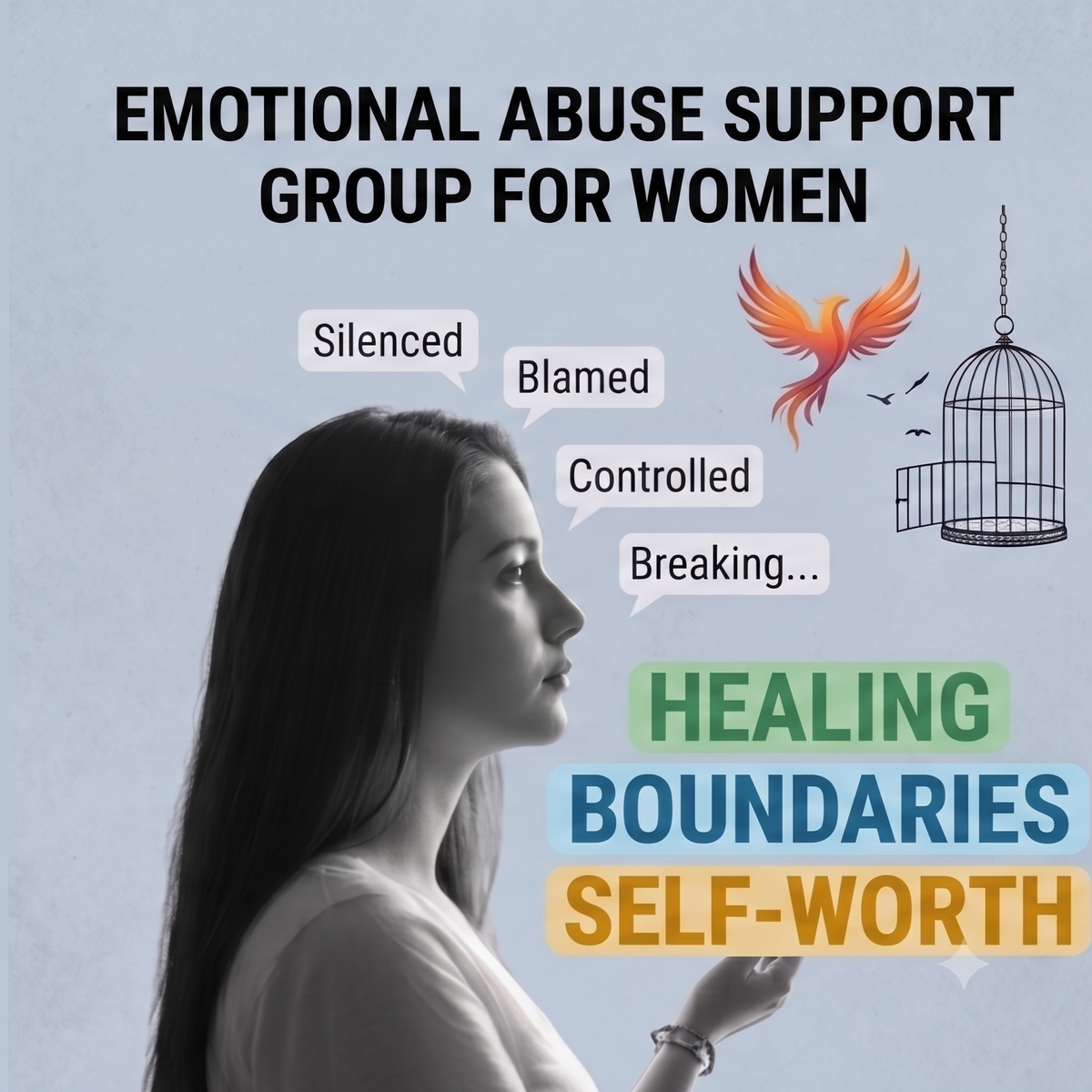
A therapist-led, choice-based support group to understand experiences of emotional abuse, its personal and relational consequences, to build self-trust, and move toward greater safety, agency, and emotional stability. This support group seeks to bring a sense of recognition, validation, and community to help navigate through emotional abuse experiences.
Starts 28th October, 2026
Starts 28th October, 2026
6 Zoom sessions | Every Wednesday at 8:00 PM IST | 75 minutes
6 Zoom sessions | Every Wednesday at 8:00 PM IST | 75 minutes
Confidential | Small group, 6-8 people
Confidential | Small group, 6-8 people
Group Type: Support Group
Group Type: Support Group
Includes 3 Free Peer Calls*
Includes 3 Free Peer Calls*
Led by Therapist
Led by Therapist
Couldn't load pickup availability
Where should we notify you?
Enter your WhatsApp number and we'll let you know when we start this on your preferred time.
Only for updates about this timing.
Please enter a valid 10-digit mobile number.
Vote recorded
We'll WhatsApp you if we launch this timing.

Who is the Group for?
Goals of the Group
Glimpse of the regime
Session 1: Creating Safety and Understanding Emotional Abuse
Session 2: When Love and Harm Coexist: Exploring Relationship Decisions
Session 3 & 4 : Moving beyond Emotional Traps and Reclaiming Choice
Session 5 & 6: Reconnecting with Personal Choice and Rebuilding Trust
Meet your Facilitator

Deepthi Jose

Interested in multiple groups?
If you plan to join more than one group this year, this is the most cost-effective way to do it.
- Unlimited Support Groups – Join any eligible group throughout the year at no extra cost.
- Exclusive Weekly Series – Join our weekly Women/Men Unfiltered sessions on relationships, career, identity, and mental health.
- 24 Free Peer Calls – Connect one-on-one with other members for support and shared experiences.
FAQs
What are SoulUp Groups?
At SoulUp, you'll meet people who get what you're going through and might be living some of the same realities. People looking for extraordinary conversations, just like you.
✔️ Small group, 6-8 people
✔️ Every meeting led by a world-class facilitator
✔️ Weekly 75-minute online video sessions
How is confidentiality maintained in Groups?
Confidentiality in Support Groups is maintained using secure meeting links and enabling waiting rooms to control participant access. Participants are bound by mutual confidentiality clause within the group. and sessions are not recorded without explicit consent.
Are Group sessions done on video?
Yes, all group sessions are conducted on video via Zoom.
While participants are allowed to use pseudonyms - they need to be on video to make the most of the session.
What is SoulUp's refund policy on Groups?
1. After you have registered for the group and you'd like to opt out:
- Full refund if you cancel 30 days before the group start date.
- 50% refund if you cancel 16-30 days before the group start date.
- No refund if you cancel 0-15 days before the group start date.
2. If SoulUp cancels a group, we will refund the entire signup fee.
3. If SoulUp reschedules a group by more than 2 weeks, we will inform you and give you an option to opt out and get a full refund.
4. SoulUp reserves the right to remove participants from a group if found unsuitable to the group. In such cases participants are given the option of claiming the pro-rata amount left as a refund or using it for another service on SoulUp.
Can I use multiple discounts while signing up for a group?
You can use only 1 type discount while signing up for a group. Cash backs cannot be coupled with discounts either.
* Are FREE Peer calls available to everyone who signs-up for this group?
You can book 3 Peer calls for FREE as part of signing up for this group.
Please note: This is only available to first-time participants of a SoulUp group (those trying a SoulUp group for the first time).
How long has SoulUp been around?
SoulUp was founded in 2022 by Punita Mittal and Mahak Maheshwari - a team of IIT Delhi and IIT Bombay with more than 20 years of combined healthcare experience. SoulUp is redefining mental health through groups that are not only effective but also fun, social, and challenging.
More about Support Groups & Therapy Groups:
1. What is an online therapy or support group?
Online therapy groups or support groups are structured, therapist-led sessions where participants gather virtually to discuss and work on specific mental health or personal growth topics.
These groups offer a supportive environment and help members learn coping strategies and relevant techniques from the therapist. Participants offer each other encouragement, share advice, and provide emotional support, helping one another feel less isolated.
2. What benefits can I expect from joining an online therapy group or support group?
Participants in online therapy groups often experience improved mental health, a greater sense of connection, and enhanced coping skills. Group therapy provides structured guidance from a therapist, which can lead to valuable insights and personal growth.
3. How does online group therapy compare to one-on-one therapy?
One-on-one therapy is personalized, focusing solely on your needs, which can be ideal for in-depth, private work with a therapist.
Online group therapy, however, offers a sense of community and shared experience. In addition to learning from the therapist, members get to connect with others facing similar challenges. Group settings provide diverse perspectives and reduce isolation, which participants find valuable.
4. Are online groups effective?
Yes, studies show that online groups can be as effective as in-person groups. The online format provides convenience and accessibility while offering the same structured therapeutic benefits, especially for those who prefer the comfort of their home environment.
5. Will I have to share my personal journey in the group?
Sharing is encouraged but never forced. Participants are free to share only what they feel comfortable with, and many find that opening up gradually is natural and helpful for their own growth.
6. How do online therapy groups or support groups handle difficult emotions that arise?
The therapist leading the group is trained to manage challenging emotions. They provide tools and strategies for coping, helping participants process feelings safely.
7. Can I attend online therapy groups if I’m already in individual therapy?
Yes, many people find that group therapy superbly complements individual therapy, providing additional insights and social support, thus accelerating their healing. Also, users often join group therapy for a topic that they are not focusing on in their individual therapy sessions. Often, therapists themselves recommend their clients to group therapy for a specific area of their life.
8. How do I know if a support group is right for me?
If you’re looking for shared experiences and emotional support rather than structured therapeutic guidance, a support group may be ideal. Otherwise, consider a therapy group for a more structured approach.
You can also join more than one group if you feel it will benefit you, especially if each group focuses on a different aspect of your mental health journey.